Tattoo style
Blackwork Tattoos: Dark & Halloween Designs
Quick answer: Blackwork tattoos use only black ink, often in large solid fills with negative-space highlights from bare skin. The bold contrast makes bats, ravens, haunted houses and black roses look striking. Black is the most stable pigment, so well-packed blackwork ages extremely well and lasts decades on most placements.
- Line work
- Bold outline and solid fills
- Palette
- Black only
- Shading
- Solid black, negative space, sometimes dotwork shading
- How it ages
- Excellent: black is the most stable pigment
- Relative time
- 1.1× a traditional piece

What is blackwork?
Blackwork ranges from heavy solid black fills to illustrative black-only designs. It is a natural fit for silhouettes such as bats, ravens, haunted houses and black roses, where negative space creates the highlights.
History
Blackwork draws on Polynesian and Bornean tribal traditions, as well as woodcut and engraving illustration; it surged in popularity in the 2010s.
Dark motifs in blackwork
27 motifs suit this style. Each links to a design guide.
 Blackwork Skeleton HandBlackwork Skull
 Blackwork Memento Mori
 Blackwork Hourglass
 Blackwork Grim Reaper
 Blackwork Coffin
 Blackwork Black Rose
 Blackwork Dagger
 Blackwork Death's-Head Moth
 Blackwork Jack-o'-Lantern
 Blackwork Ghost
 Blackwork Black Cat
 Blackwork Witch Hat
 Blackwork Haunted House
 Blackwork Vampire
 Blackwork Spider
 Blackwork Spider Web
 Blackwork Bat
 Blackwork Raven
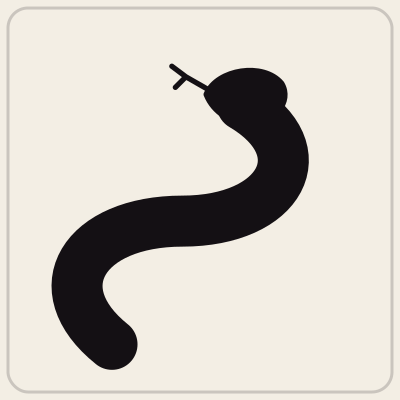 Blackwork Serpent
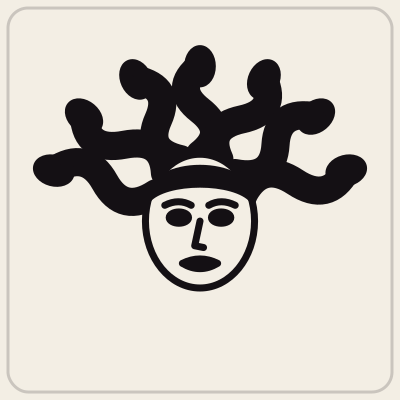 Blackwork Medusa
 Blackwork Werewolf
 Blackwork Ouroboros
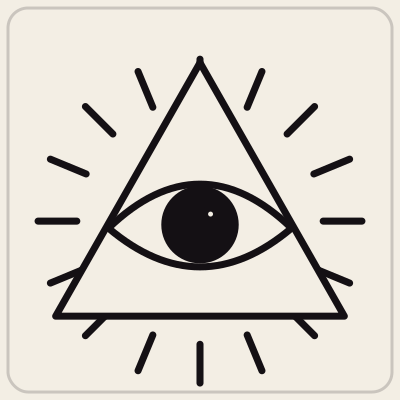 Blackwork All-Seeing Eye
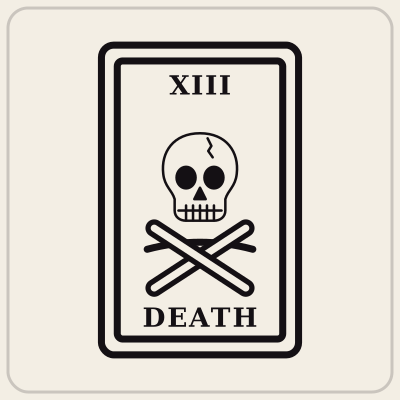 Blackwork Death Tarot Card
 Blackwork Spirit Board Planchette
 Blackwork Crescent Moon
Placement advice
Blackwork needs roughly 1× the minimum size of a traditional version of the same motif.
Finding the right artist
Ask to see healed solid black work: it should be even and fully packed with no patchiness.
Key takeaways for blackwork tattoos
- Look: Bold outline and solid fills; black only; solid black, negative space, sometimes dotwork shading.
- Aging: Excellent: black is the most stable pigment.
- Size: about 1× the minimum size of a traditional version of the same motif.
- Session time: about 1.1× a traditional piece of the same size.
Compare styles
| Style | Line | Palette | Aging |
|---|---|---|---|
| American Traditional | Bold, consistent black outline (often a 9–14 round liner) | Red, yellow, green, black and skin tone | Excellent: one of the best-aging styles |
| Neo-Traditional | Bold outline with varied line weights | Jewel tones: burgundy, teal, violet, ochre | Very good |
| Blackwork | Bold outline and solid fills | Black only | Excellent: black is the most stable pigment |
| Fine Line | Single needle or 3RL thin lines | Mostly black, sometimes soft color washes | Fair: lines can soften and blur over the years |
| Black & Grey Realism | Minimal outlines; form defined by shading | Black and grey washes | Good when large; small realism blurs |
| Dotwork | Fine-to-medium outline | Black, sometimes with red accents | Good: dots soften slightly but texture remains |
| Sketch | Loose, multiple overlapping lines | Black with light color washes | Fair: loose lines can blur if too small |
| Ignorant Style | Uneven, hand-drawn lines | Mostly black | Fair to good: simple lines hold if not too thin |
| Trash Polka | Bold outlines mixed with realism | Black and red only | Good: black and red are strong pigments |
| Minimalist | Thin to medium simple lines | Black, sometimes one accent color | Good if lines are not too thin |
Frequently asked questions
Is blackwork painful?
Blackwork can feel more painful than linework on the same spot, because solid fills require more passes over the skin. Placement still matters most, so a forearm blackwork piece hurts less than one on the ribs. Breaking large fills into separate sessions keeps the intensity manageable for most people.
Does blackwork fade?
No, blackwork fades very little, because black ink is the most stable pigment. Well-packed blackwork lasts decades and keeps its contrast. When you choose an artist, ask to see healed solid black work: it should look even and fully packed, with no patchiness or grey spots.
Can blackwork cover old tattoos?
Yes, blackwork can cover old tattoos and is one of the most common cover-up approaches. Dense black fills hide earlier ink that lighter styles can't conceal. Your artist will design the new piece around the old one, placing solid black areas where the previous tattoo is darkest.