Tattoo style
Dotwork Tattoos: Dark & Halloween Designs
Quick answer: Dotwork tattoos build shading from thousands of tiny dots, a stippling technique that gives an engraved, antique texture. The style suits occult symbols, moths, moons, ouroboros and sacred geometry. Dotwork ages well: the dots soften slightly over time, but the texture remains clearly visible for years.
- Line work
- Fine-to-medium outline
- Palette
- Black, sometimes with red accents
- Shading
- Stippled gradients
- How it ages
- Good: dots soften slightly but texture remains
- Relative time
- 1.5× a traditional piece
What is dotwork?
Dotwork shading feels like an antique engraving. It pairs especially well with mystic designs: all-seeing eyes, ouroboros, moths, moons and mandalas.
History
Stippling comes from printmaking and engraving; it became a distinct tattoo style in the 2000s alongside geometric and blackwork movements.
Dark motifs in dotwork
18 motifs suit this style. Each links to a design guide.
Dotwork Skull Dotwork Sugar Skull
 Dotwork Memento Mori
 Dotwork Hourglass
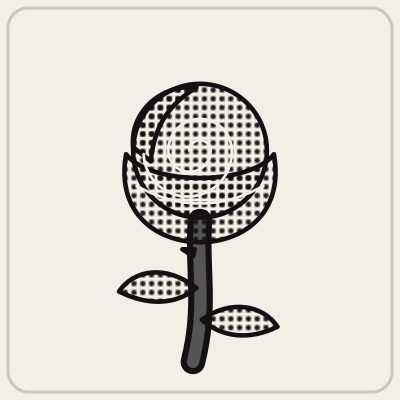 Dotwork Black Rose
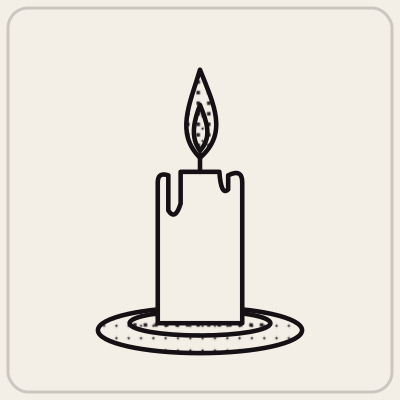 Dotwork Candle
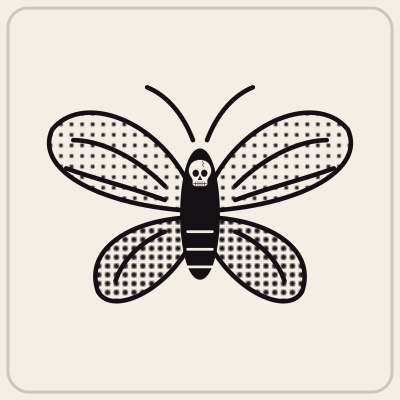 Dotwork Death's-Head Moth
 Dotwork Spider
 Dotwork Bat
 Dotwork Raven
 Dotwork Serpent
 Dotwork Medusa
 Dotwork Werewolf
 Dotwork Ouroboros
 Dotwork All-Seeing Eye
 Dotwork Death Tarot Card
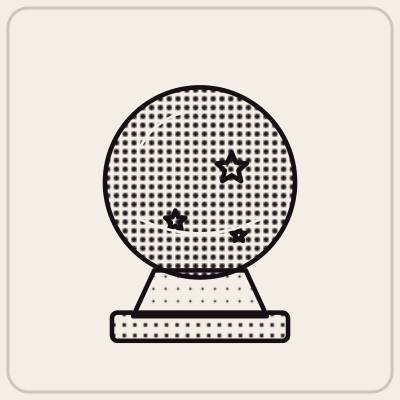 Dotwork Crystal Ball
 Dotwork Crescent Moon
Placement advice
Dotwork needs roughly 1.3× the minimum size of a traditional version of the same motif.
Avoid very small dotwork pieces on: Finger.
Finding the right artist
Look for consistent dot density and smooth gradients in healed work.
Key takeaways for dotwork tattoos
- Look: Fine-to-medium outline; black, sometimes with red accents; stippled gradients.
- Aging: Good: dots soften slightly but texture remains.
- Size: about 1.3× the minimum size of a traditional version of the same motif.
- Session time: about 1.5× a traditional piece of the same size.
- Use with caution on: Finger.
Compare styles
| Style | Line | Palette | Aging |
|---|---|---|---|
| American Traditional | Bold, consistent black outline (often a 9–14 round liner) | Red, yellow, green, black and skin tone | Excellent: one of the best-aging styles |
| Neo-Traditional | Bold outline with varied line weights | Jewel tones: burgundy, teal, violet, ochre | Very good |
| Blackwork | Bold outline and solid fills | Black only | Excellent: black is the most stable pigment |
| Fine Line | Single needle or 3RL thin lines | Mostly black, sometimes soft color washes | Fair: lines can soften and blur over the years |
| Black & Grey Realism | Minimal outlines; form defined by shading | Black and grey washes | Good when large; small realism blurs |
| Dotwork | Fine-to-medium outline | Black, sometimes with red accents | Good: dots soften slightly but texture remains |
| Sketch | Loose, multiple overlapping lines | Black with light color washes | Fair: loose lines can blur if too small |
| Ignorant Style | Uneven, hand-drawn lines | Mostly black | Fair to good: simple lines hold if not too thin |
| Trash Polka | Bold outlines mixed with realism | Black and red only | Good: black and red are strong pigments |
| Minimalist | Thin to medium simple lines | Black, sometimes one accent color | Good if lines are not too thin |
Frequently asked questions
Does dotwork hurt more?
Not necessarily. Dotwork can take longer than other shading, but many people find the dotting less intense than heavy shading. Stippled gradients build up gradually rather than through solid packing. Placement still decides most of the pain, so a forearm piece feels easier than one on the ribs.
Does dotwork fade?
Dotwork fades only a little. The dots soften slightly with time, which gives a smoother gradient as the tattoo ages. The engraved texture stays readable, so look for consistent dot density and smooth gradients in an artist's healed work before you book your session.
What motifs suit dotwork?
Motifs that suit dotwork include occult symbols, moths, moons, ouroboros and mandalas. Stippled shading gives them an antique engraving feel that matches their mystic themes. All-seeing eyes and sacred geometry also work well, and red accents can highlight a single element against the black dots.