Tattoo style
Trash Polka Tattoos: Dark & Halloween Designs
Quick answer: Trash polka tattoos use black and red ink to combine realistic elements, abstract brush strokes and collage typography into chaotic, graphic compositions. Searches rose about 90% in the US in October 2026. Black and red are strong pigments, so the style ages well, but it needs size.
- Line work
- Bold outlines mixed with realism
- Palette
- Black and red only
- Shading
- Realism shading plus brush strokes and splatter
- How it ages
- Good: black and red are strong pigments
- Relative time
- 1.4× a traditional piece

What is trash polka?
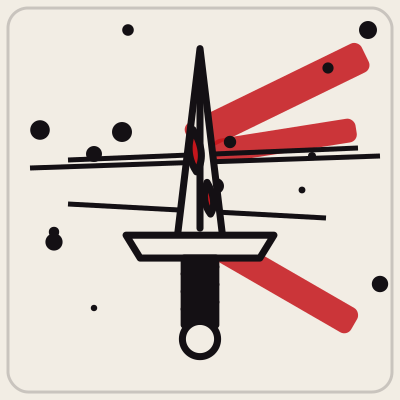
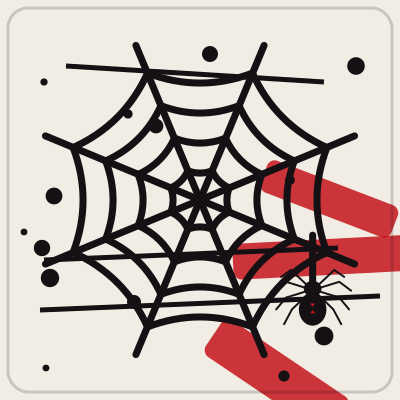
Created as a deliberate clash of realism and trash, the style is bold and aggressive, making it perfect for skulls, daggers, ravens and serpents set against red smears and black splatter.
History
Trash polka was developed by Simone Pfaff and Volko Merschky at Buena Vista Tattoo Club in Würzburg, Germany, in the late 1990s.
Dark motifs in trash polka
7 motifs suit this style. Each links to a design guide.




Placement advice
Trash Polka needs roughly 1.4× the minimum size of a traditional version of the same motif.
Avoid very small trash polka pieces on: Finger, Behind the Ear, Wrist.
Finding the right artist
Trash polka needs size and a specialist who designs compositions to flow with the body.
Key takeaways for trash polka tattoos
- Look: Bold outlines mixed with realism; black and red only; realism shading plus brush strokes and splatter.
- Aging: Good: black and red are strong pigments.
- Size: about 1.4× the minimum size of a traditional version of the same motif.
- Session time: about 1.4× a traditional piece of the same size.
- Use with caution on: Finger, Behind the Ear, Wrist.
Compare styles
| Style | Line | Palette | Aging |
|---|---|---|---|
| American Traditional | Bold, consistent black outline (often a 9–14 round liner) | Red, yellow, green, black and skin tone | Excellent: one of the best-aging styles |
| Neo-Traditional | Bold outline with varied line weights | Jewel tones: burgundy, teal, violet, ochre | Very good |
| Blackwork | Bold outline and solid fills | Black only | Excellent: black is the most stable pigment |
| Fine Line | Single needle or 3RL thin lines | Mostly black, sometimes soft color washes | Fair: lines can soften and blur over the years |
| Black & Grey Realism | Minimal outlines; form defined by shading | Black and grey washes | Good when large; small realism blurs |
| Dotwork | Fine-to-medium outline | Black, sometimes with red accents | Good: dots soften slightly but texture remains |
| Sketch | Loose, multiple overlapping lines | Black with light color washes | Fair: loose lines can blur if too small |
| Ignorant Style | Uneven, hand-drawn lines | Mostly black | Fair to good: simple lines hold if not too thin |
| Trash Polka | Bold outlines mixed with realism | Black and red only | Good: black and red are strong pigments |
| Minimalist | Thin to medium simple lines | Black, sometimes one accent color | Good if lines are not too thin |
Frequently asked questions
What is trash polka?
Trash polka is a German tattoo style combining realism, abstract black and red strokes and collage typography. Simone Pfaff and Volko Merschky developed it at Buena Vista Tattoo Club in Würzburg in the late 1990s. Skulls, daggers, ravens and serpents set against red smears are typical subjects.
Can trash polka be small?
No, trash polka can't really be small. The style needs room for its collage elements: realism, brush strokes, splatter and typography. Avoid fingers, wrists and behind the ear, and work with a specialist who designs the composition to flow with the body across a large area.
Does red ink in trash polka fade?
Red ink in trash polka is a strong pigment, but it can soften over the years. Sun protection helps the red stay bright, so cover the tattoo or use sunscreen outdoors. The black elements hold up well, which keeps the composition's graphic contrast readable as it ages.